

Travel Oregon City: What the Heck Is a DMMO, and What Are They Doing to Build Tourism in OC?
Oregon City now has its first dedicated destination management organization, and in under six months of active programming it has rebuilt the city’s tourism marketing engine, brought long-siloed organizations to the same table, and laid the groundwork for a visitor economy designed to serve residents first.
Event Recap
The May 2026 luncheon introduced attendees to the DMMO, a modern framework that balances destination promotion with active resource management. Sylecia Johnston, Contract Administrator for Destination Oregon City, walked the audience through how that framework works, what her organization has accomplished in its first months, and how her global experience is being put to work helping Oregon City protect its unique character while building a thriving, visitor-ready economy.
Kent Zeigler thanked the Abernethy Center staff for another excellent lunch. Event sponsor Level Development Northwest was recognized for its redevelopment of the former courthouse site downtown, a project that will bring new ground-floor retail, an expanded Liberty Plaza, and roughly 70 apartments to Main Street. Elected officials in attendance included State Senator Mark Meek, City Commissioner Adam Marl, Chris Hawes of Clackamas Fire District, and Tessa Donnell and Sherry French of Clackamas River Water. As always, attendees submitted questions on blue cards throughout the program.
Key Takeaways
- Oregon City has a dedicated tourism organization for the first time. Destination Oregon City Inc., online at TravelOregonCity.com, is a 501(c)(6) nonprofit established in 2025 with seed funding from the city’s Transient Lodging Tax reserve. It operates under a two-year proof-of-value agreement with the city and closes its first fiscal year in June, when Johnston delivers her first progress report to the City Commission.
- Management as well as Marketing. Modern DMOs have shifted from destination marketing to destination management, a stewardship model born partly from overtourism failures elsewhere. The goal is not simply more visitors, but the right visitors, distributed well, in a community prepared to host them.
- Tourism is an export. Visitors bring outside money into local hands, triggering a multiplier effect across hospitality, food and agriculture, retail, arts and culture, recreation, and events. Tourism is the largest service industry in the world by employment.
- The budget is small, but the leverage is real. State law directs a share of local lodging taxes to tourism promotion, and the recently passed House Bill 4148 reset that required share from 70 percent to 50 percent while giving cities flexibility over the remainder. With only one hotel in town, growing the funding base means attracting new lodging and capturing short-term rental taxes.
- Six months of programming produced measurable momentum. Social media reach grew by orders of magnitude, Oregon City placed ads in guides with a combined 625,000 print copies, a digital ad pilot filled local events, a citywide Mother’s Day campaign tested a new model, a rebuilt website launched, and a dedicated Oregon City TV episode reaching 1.35 million television homes airs in July.
- The long game is tied to Oregon City’s development pipeline. With major projects from the Abernethy Bridge to Tumwata Village in motion, the DMO is using this window to coordinate stakeholders, develop river and heritage tourism, and prepare the community for the visitors those projects will bring.
About the Speaker
Sylecia Johnston is the Contract Administrator for Destination Oregon City, the city’s first dedicated destination management organization. She began her career at the Monterey County Convention and Visitors Bureau and has spent more than 15 years leading tourism strategy and development across four continents, including USAID-funded programs in Bangladesh and the South Caucasus, where she established new destination management organizations in emerging destinations. Most recently she served as DMO Solution Lead at Solimar International, a global sustainable tourism consultancy. A certified Project Management Professional with a Master’s in Sustainable Destination Management from George Washington University, she has traveled to roughly 45 nations on six continents. An Oregon resident for more than a decade, she told the audience that after USAID was closed and her position eliminated, the Oregon City contract offered the rare chance to invest her expertise back into her own community.
Inside the Presentation
From Marketing to Management
Johnston opened by defining a DMO. DMO historically stood for destination marketing organization, but over the past decade the industry has embraced a broader stewardship mandate, and the second M now stands for management. The shift is partly a response to overtourism: Barcelona residents spraying tourists with water guns, Machu Picchu capping annual visitors to protect the site itself. Marketing alone can succeed too well.
She distinguished DMOs from destination management companies, which are private for-profit firms that build itineraries for inbound groups, and from convention and visitors bureaus, which court meeting and event planners. Whatever the flavor, a DMO is any organization that develops and promotes a destination to increase visitation, economic impact, and community benefit.
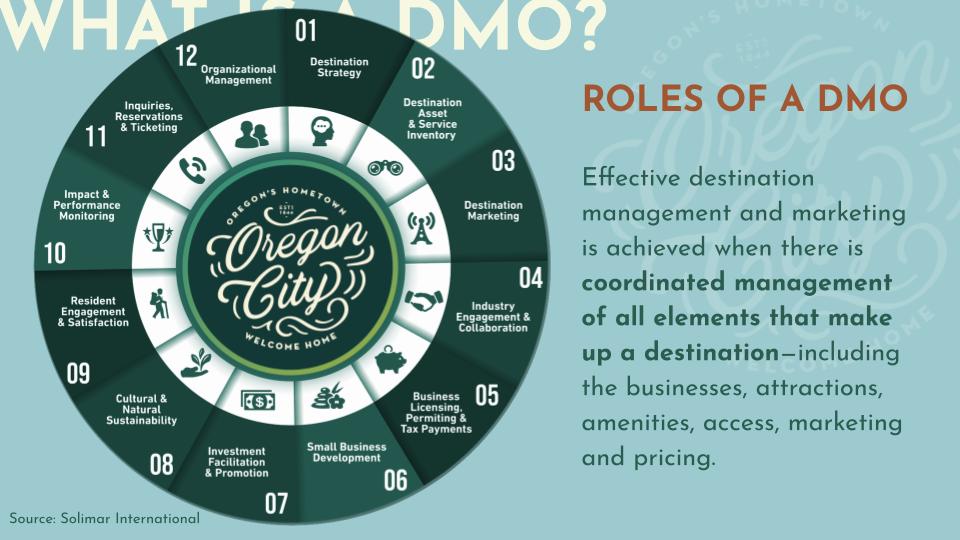
A wheel of DMO roles adapted from Solimar International, from destination strategy and marketing through small business development, resident engagement, and impact monitoring, made the scope of the work concrete. Johnston emphasized that no organization fills every role at once. Roles are built over time as capacity and funding grow, and some are skipped entirely when other local organizations already cover them.
Destinations generally cycle through three phases: development, promotion, and management. Where does Oregon City sit? In a combination of development and promotion, with active redevelopment underway across the city.
How Lodging Taxes Fund the Work
Most DMOs are funded by lodging taxes, on the logic that visitors generate the tax, the tax funds tourism development, and better tourism draws more visitors. That is why DMO services, from marketing to business support, are generally free to local businesses. As DMOs mature, many also layer in private funding sources, an avenue Destination Oregon City expects to explore as it grows.
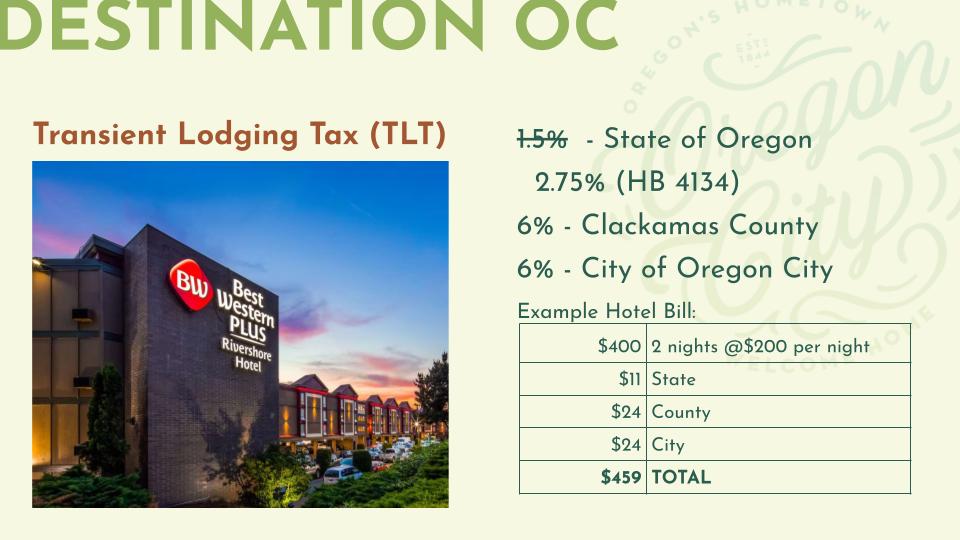
Johnston walked through the math using the city’s one hotel, the Best Western Plus Rivershore. A visitor paying $200 a night for two nights pays about $11 in state lodging tax, a rate recently raised from 1.5 to 2.75 percent by House Bill 4134, plus 6 percent each in county and city lodging taxes, roughly $24 apiece, for a total bill of $459. Half of the city’s share, $12 from that stay, flows to tourism development and promotion. Her stated dream for growing that base: a boutique hotel or historic bed and breakfast, plus a working system for collecting short-term rental taxes. Sylecia hinted, fingers crossed, that a recent property purchase in town may produce a small bed and breakfast.
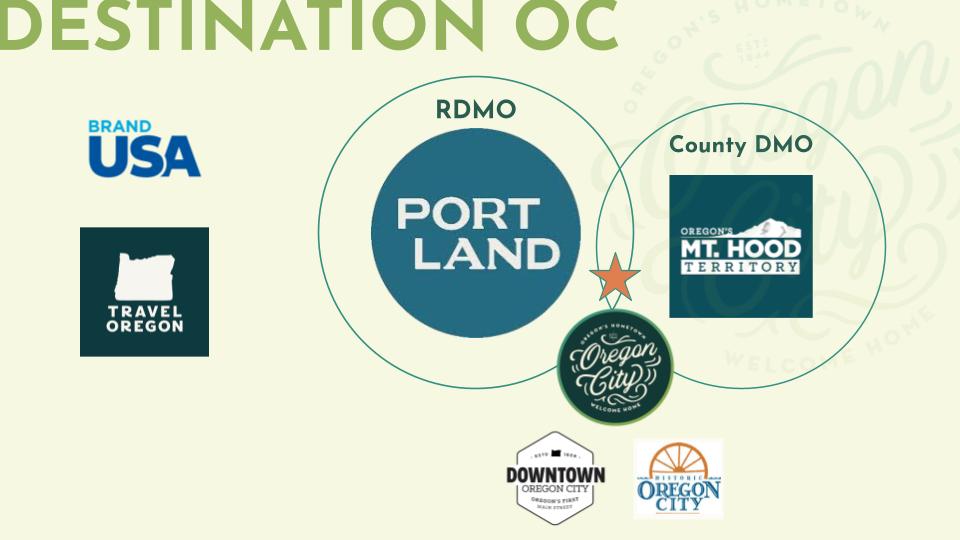
She also mapped Oregon’s unusually layered DMO funnel. Travel Oregon, a semi-independent state agency established as the Oregon Tourism Commission in 1995, divides the state into seven tourism regions. Oregon City falls under Travel Portland, whose representative attended the luncheon, while the Clackamas County Office of Tourism spans three state regions and serves as the designated regional DMO for Oregon’s Mt. Hood Territory. Two sub-destination organizations round out the local picture: the Downtown Oregon City Association and Historic Oregon City, which operates one of only eight official Oregon Welcome Centers in the state at the End of the Oregon Trail site.
The regional organizations spend their marketing dollars attracting visitors from more than 50 miles away, which means Destination Oregon City does not have to. Its target audience is people already exploring the Portland metro area and Mt. Hood Territory, including metro residents themselves. Many Portlanders, she noted, do not know they can ride Amtrak one stop from Union Station to Oregon City for $2, have never used the municipal elevator, and are unaware of the claim that Willamette Falls is the second largest waterfall by volume in the United States. What the regional partners need from Oregon City is simple: fresh stories, fresh photos, and new experiences worth talking about.
Six Months of Results
Destination Oregon City was established in 2025, presented its city-required marketing and coordination plans in November, and received approval in December, meaning it has been actively programming for just under six months. Its mission: “to promote Oregon City as a gathering place for all, by providing a variety of quality experiences through a collaborative, connected, and enduring tourism industry.” The results so far fall into two buckets.
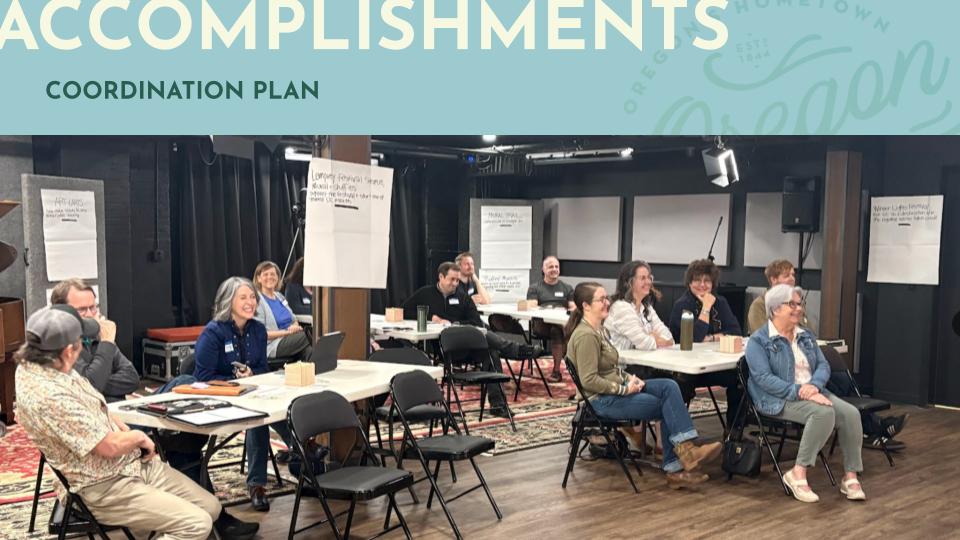
On coordination, the DMO launched quarterly tourism industry mixers, behind-the-scenes gatherings at a rotating host business, with the next set for Thursday, June 25, from 5 to 7 p.m. at Oregon City Brewing. Johnston has been presenting across the community, from Rotary and the Oregon City Youth Advisory Commission to classes at Clackamas Community College, with neighborhood association presentations planned next in the areas closest to tourism activity. The standout initiative is the Creative Action Lab, a workshop series co-hosted with the Oregon City Arts Commission in which artists and marketers drafted, budgeted, and ranked community project ideas. The Arts Commission now holds a backlog of community-created, ranked projects it can pursue grant funding for, and it submitted its first application days before the luncheon for the top-voted idea: public art celebrating the Pacific lamprey, with a support letter from Yakama Nation elders. Roundtables focused on heritage, agritourism, and river tourism are planned next.
On marketing, the numbers tell the story:
| Channel | All of Q1 (Jul-Sep) | April alone |
|---|---|---|
| Facebook page views | 405 | 40,740 |
| Instagram profile views | 1,640 | 68,423 |
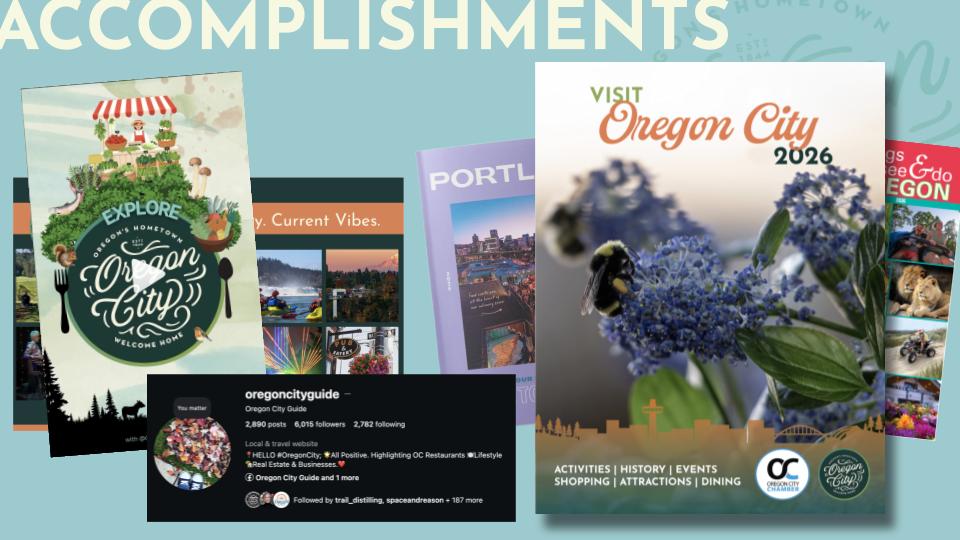
That growth came from a steady cadence of fresh content and a collaboration with the locally followed Oregon City Guide account. Print ads went into the Travel Portland Visitor Guide, the Travel Oregon Visitor Guide, and the statewide Things to See and Do brochure, a combined 625,000 physical copies plus digital distribution. Rather than produce a standalone visitor guide, the DMO partnered with the Chamber of Commerce on this year’s Visit Oregon City magazine, contributing content, photos, the art walk map, and the event calendar.
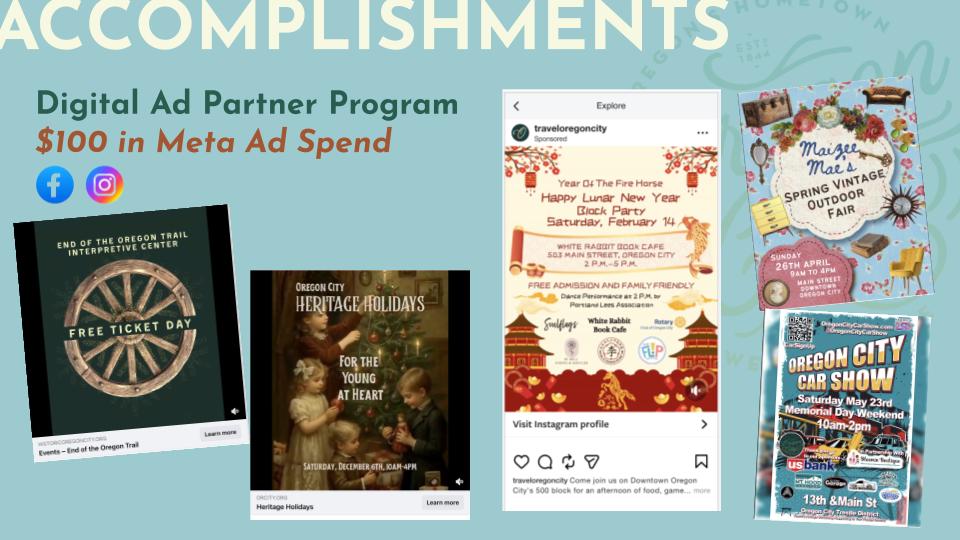
A digital ad pilot put $100 of Meta ad spend behind local event posts, with striking results: 25,000 views and 891 website clicks for the End of the Oregon Trail Free Ticket Day, 26,800 views for Heritage Holidays, more than 10,500 direct engagements for the Lunar New Year block party, 15,000 views for Maizie Mae’s Spring Vintage Outdoor Fair, and nearly 10,000 unique viewers for the Oregon City Car Show. Johnston was candid that digital reach does not always translate to attendance. An ad helped the Ermatinger House sell out its Books and Booze program, while a well-viewed lecture at the Museum of the Oregon Territory drew about 19 people. Reading that gap, she said, is exactly the DMO’s job, and she is working with a Travel Oregon paid ads specialist to optimize the program.
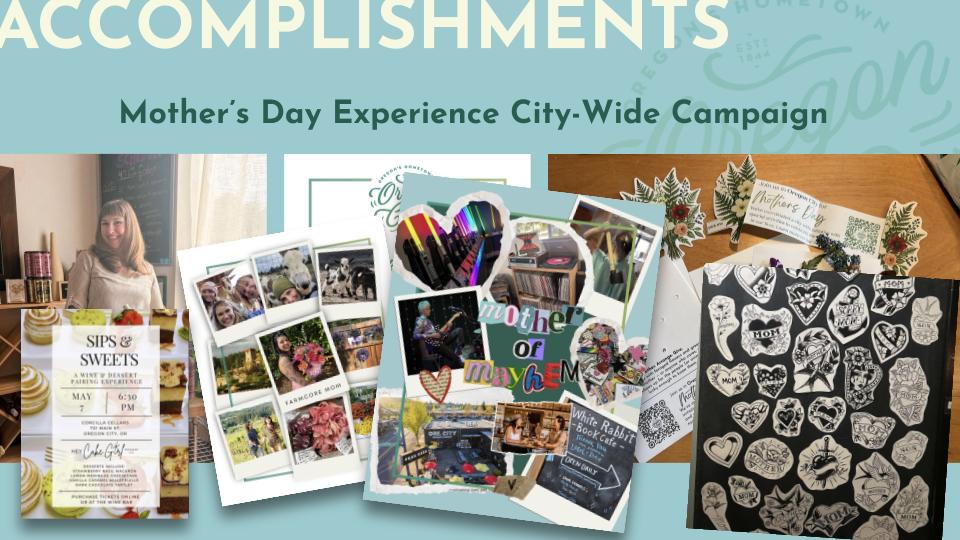
A citywide Mother’s Day campaign served as a proof of concept for positioning Oregon City as “close enough to be convenient, far enough to be special” for metro families. About 20 businesses participated at no cost, 500 interactive flyers circulated across the Portland area, and three ads drew just under 40,000 views, with participating businesses tagged and reshared across the DMO’s channels.
Two more launches rounded out the report. The DMO’s rebuilt website went live at TravelOregonCity.com, developed with Oregon City’s own Jolly Good Media, replacing a broken, outdated back end with a manageable, search and AI optimized platform featuring corrected business listings, a guest-friendly blog, and a community event calendar built to push events automatically to Travel Oregon’s statewide system.
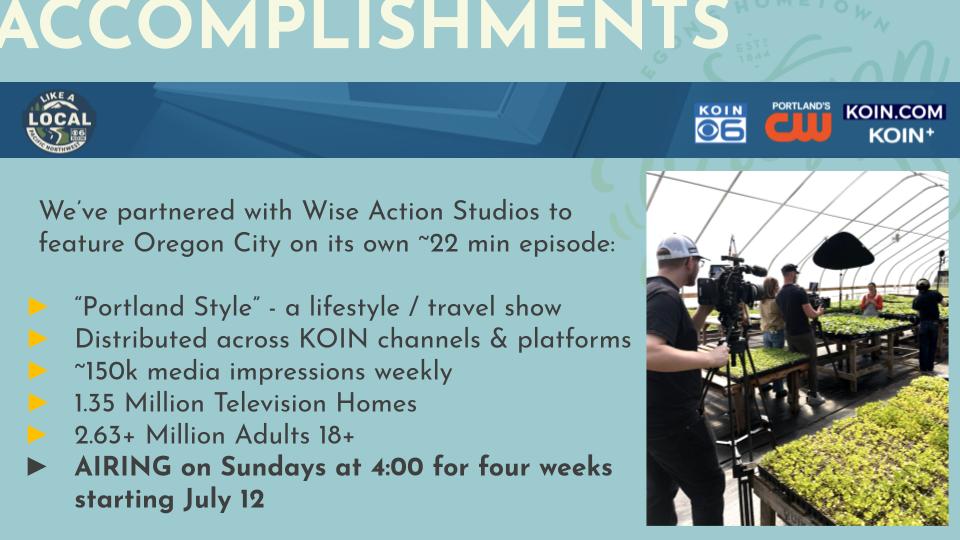
And Oregon City will star in its own roughly 22-minute episode of Portland Style, a lifestyle travel series produced with Wise Action Studios and distributed across KOIN channels and platforms, reaching 1.35 million television homes and drawing roughly 150,000 media impressions weekly. The episode airs Sundays at 4 p.m. for four weeks beginning July 12. Four paid digital media interns from Clackamas Community College’s cooperative work experience program filmed alongside the production crew and will appear in the credits.
Looking 15 Years Out
Johnston closed with the pipeline: a 12-member marketing committee convening in June, a first visitor experience research report with primary data collection to follow, and a visitor experience gap analysis identifying what infrastructure, amenities, and services the destination is missing.
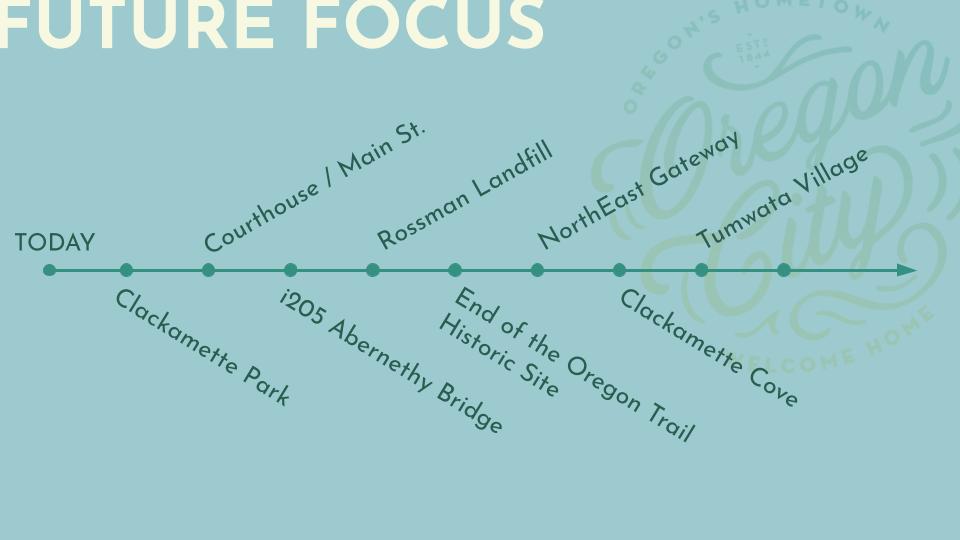
She also laid out the remarkable run of development projects ahead of the city, from Clackamette Park, the courthouse block on Main Street, and the I-205 Abernethy Bridge to the Rossman Landfill, the End of the Oregon Trail Historic Site, the NorthEast Gateway, Clackamette Cove, and Tumwata Village. Rather than wait for those projects to finish, she argued, the question is what the community can do in the meantime, supporting small businesses affected by construction and preparing the workforce and streetscape for what is coming. When Tumwata Village opens, Oregon City will have a lot of tourists.
Her vision for five, ten, and fifteen years out: riverfront paths where residents and visitors linger together, wayfinding so clear that a first-time visitor stepping off a ferry dock or the Amtrak platform knows exactly where to go next, indigenous history honored, and arts, culture, and everyday life woven into a shared sense of place. Not a theme park version of Oregon City, she stressed, but the real thing, with a tourism economy that lifts the whole community.
Questions and Answers
Foru visitors are given the opportunity to write question on blue cards throughout the forum.
Johnston confirmed the DMO is a one-person contract operation supported by an engaged seven-member board representing different tourism sectors, running on $125,000 a year paid quarterly by the city. Measuring economic impact is a genuine challenge: with one hotel, the industry-standard occupancy metrics reveal little, and tools like geofencing and credit card spending data are priced beyond the budget.
Several questions focused on funding. Oregon City receives no lodging tax from the state or county; the DMO is funded solely from the city’s own collections. Short-term rentals represent untapped revenue, and while the county is building a remittance system, the city’s registration process needs clarifying work she hopes to pursue with the Economic Development Office.
River tourism drew the most pointed discussion. With I-205 bridge construction driving away fishing guides and kayak rentals, some operators have reportedly lost half their business. Johnston called the underused rivers her biggest disappointment on arrival and the destination’s greatest untapped potential, and pointed to the DMO’s advocacy role, telling visitors the city is still open, alongside the planned river tourism roundtable with Parks and Recreation.
On heritage, she affirmed history as central to the brand while arguing the sites need refreshed programming and connections beyond their traditional silos, citing her strategic planning work with the McLoughlin Memorial Association and the Heritage Coordinating Committee. Asked how to win over residents skeptical of tourism, she pointed to education, sentiment surveys, and the simple observation that beloved local businesses stay open because visitor dollars supplement resident spending. Asked about artificial intelligence, she said she keeps it out of marketing and creative work, reserving limited use for behind-the-scenes operations. And yes, she believes Oregon City can turn visitors into residents, investors, and business owners, potentially through a tourism-focused version of the city’s BizPod incubator program.
Get Involved
Johnston ended with open invitations. Prospective travel writers can pitch guest articles for the new blog, river tourism operators can join the upcoming roundtable, and anyone can reach her at admin@traveloregoncity.com or through TravelOregonCity.com.
Thank you for reading! Share this post and help keep Oregon City businesses informed. Also consider coming to our next Oregon City Business Alliance Forum. If you agree with the mission of the OCBA consider becoming a member.